
Naik Nenavath, et al. (2026)
Pre-print, not peer reviewed – 2026
Abstract
VSV-G-pseudotyped lentiviral vectors (LVVs) enable highly efficient ex vivo gene delivery through the broadly expressed LDL receptor (LDLR) but lack the cell-type specificity required for in vivo applications.
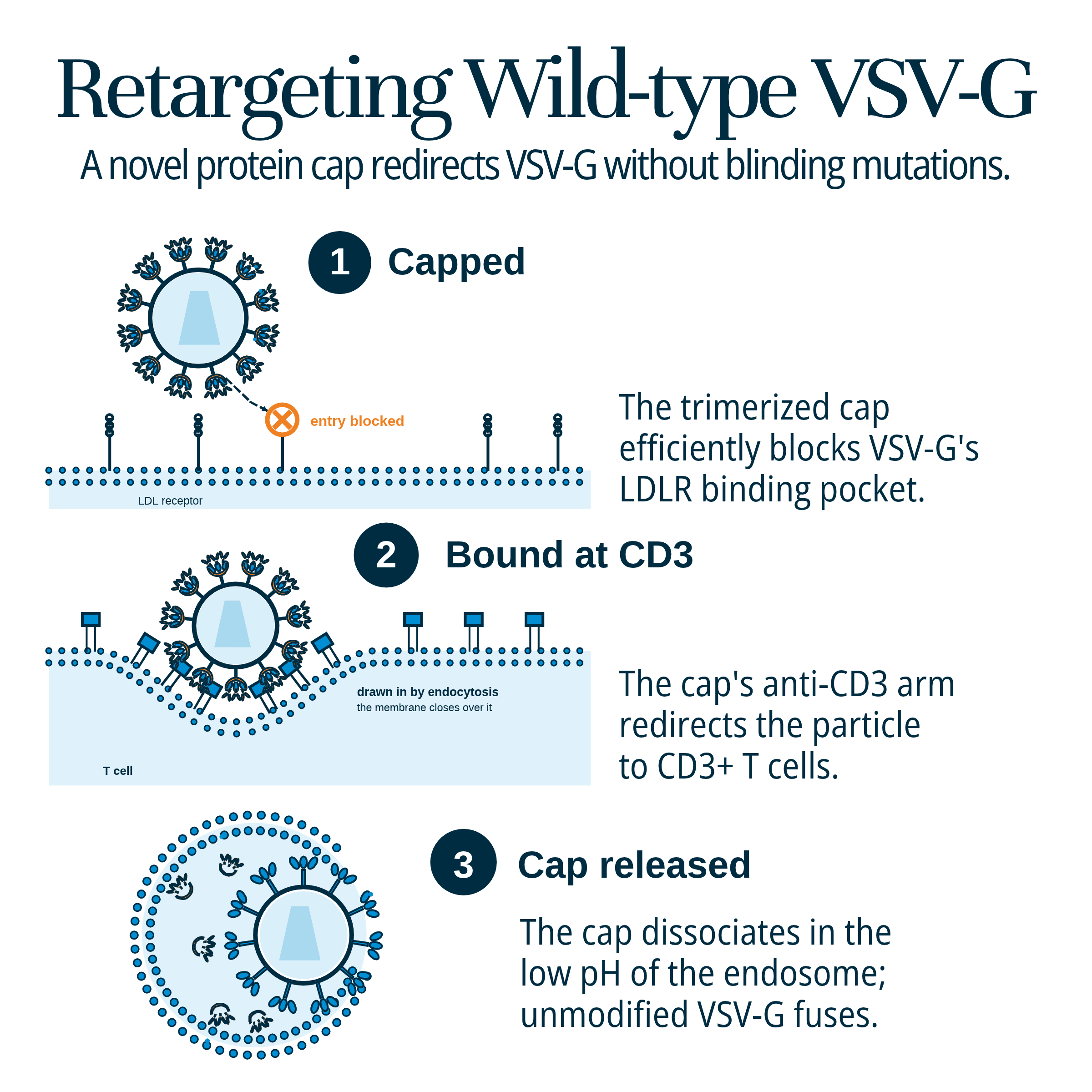
We propose an approach for directing VSV- and VSV-G-pseudotyped viral vectorsto specific cell types. To this end, we designed reversible bispecific engager proteins consisting of the VSV-G binding domains of LDLR fused to ligands or antibodies targeting cell-type
To provide cell-type specificity, we developed reversible engagers consisting of a cell-specific ligand or antibody fused to the ~40-aminoacid VSV-G-binding domains of LDLR. Following endocytosis, the engager dissociates, releasing unmodified VSV-G for efficient delivery of the genetic cargo. An engager comprising the CEACAM8 N-terminal domain enables selective transduction of CEACAM6-positive epithelial cells. A trimeric CEACAM8-based engager matching the VSV-G homotrimeric spike blocked non-specific VSV infection through LDLR with an IC50 of 16.7 pM, while enabling effective VSV-mediated lysis of CEACAM6-positive tumor cells. An anti-CD3-based trimeric engager selectively transduced non-preactivated T cells in human PBMCs with high transduction efficiency. Engager-mediated in vivo CAR T cell generation resulted in sustained control of human OPM2 multiple myeloma tumors in NSG mice. This platform may further advance in vivo gene therapy, including in vivo CAR T-cell therapy and tumor-directed oncolytic virotherapy.