The Raji-Fluc-Puro/CD19-KO cell line stably expresses firefly luciferase and does not express CD19. To generate this cell line, Raji-Fluc-Puro (Imanis #CL161) cells were transfected with Cas9-gRNA ribonucleoprotein complexes targeting human CD19. Individual cell clones were generated using a methylcellulose based semi-solid medium and screened for CD19 expression by flow cytometry. Sequencing of the targeted CD19 region confirmed heterologous genetic knock-out in the selected cell clone.
This cell line has been tested for mycoplasma contamination and is certified mycoplasma free.
The parental Raji cell line was licensed and purchased directly from ATCC*.
This cell line is also available for purchase as a pair with the Raji-Fluc-Puro (CD19 positive) cell line, for a discounted rate.
*The ATCC trademark and trade name and any and all ATCC catalog numbers are trademarks of the American Type Culture Collection.
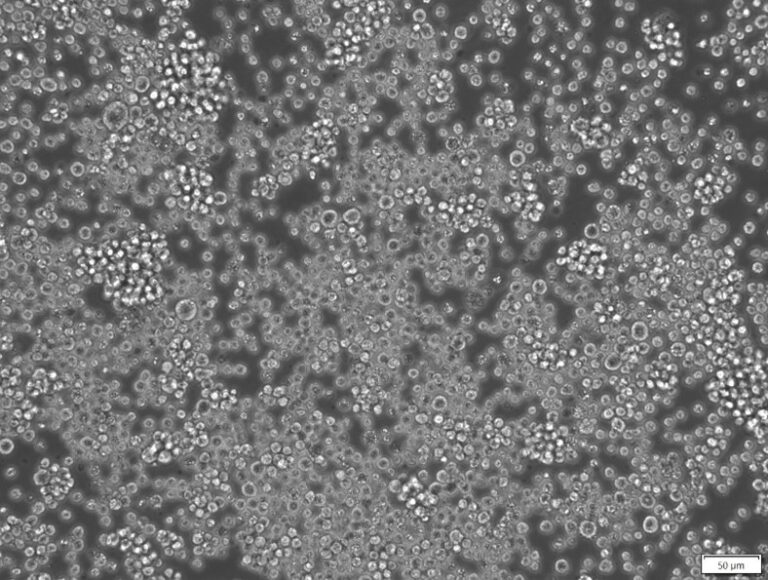 Phase cell photo taken at 200x magnification
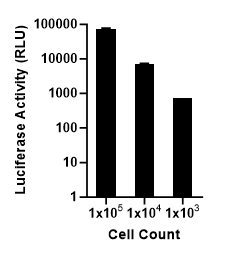 The indicated number of cells were placed in wells of a 96-well plate. After the addition of 15 mg/mL d-luciferin, bioluminescence was immediately read using a microplate reader.
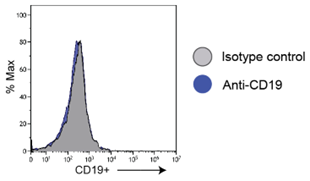
Raji-Fluc-Puro/CD19-KO cells were stained with an anti-CD19 (blue) or isotype control (grey) antibody and analyzed by flow cytometry.
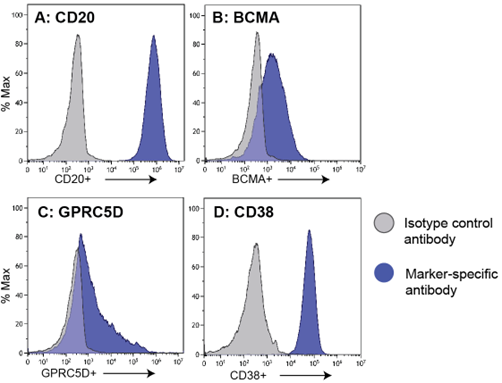 Raji-Fluc-Puro/CD19-KO cells (blue) were stained with anti-CD20 (A), anti-BCMA (B), anti-GPRC5D (C), anti-CD38 (D), or isotype control (grey; all panels) antibody and analyzed by flow cytometry.
Complete Growth Medium: ATCC-formulated RPMI-1640 supplemented with 10% fetal bovine serum (FBS), 10 mM HEPES, and 1% Penicillin/Streptomycin.
For long-term maintenance (more than two to three weeks) addition of 5 µg/mL of puromycin to the media is recommended to maintain high Fluc expression.
These cells should be grown in the indicated medium and subcultured as needed to maintain a density between 2 x 10⁵ and 3 x 10⁶ cells/mL. The cells can be passaged by dilution in fresh medium, with occasional passaging using centrifugation to limit the amount of debris in cultures.
These cells tend to form clumps, therefore daily gentle pipetting using a serological pipette is recommended for optimal cell growth and viability.
These cells are suitable for in vitro and in vivo experimentation. The Fluc transgene facilitates in vivo noninvasive bioluminescent imaging of implanted cells and quantitation of cells in vitro.
These cells were generated via lentiviral vector transduction. The lentiviral vectors used for transduction were self-inactivating (SIN) vectors in which the viral enhancer and promoter have been deleted. Transcription inactivation of the LTR in the SIN provirus increases biosafety by preventing mobilization by replication competent viruses and enables regulated expression of the genes from the internal promoters without cis-acting effects of the LTR1. Nevertheless, all work with these cells should be performed under biosafety-level 2 (BSL2) conditions by trained personnel. Institutional requirements may permit handling of these cells under BSL1 conditions if certain criteria are met.

Don’t see what you need in our catalog? Our scientific team engineers cell lines, viral vectors, and assays and provides the characterization data you need to move forward with confidence.