A549-iRFP-Puro is a polyclonal population of the human lung carcinoma cell line A549 (ATCC® CCL-185™) . To achieve stable reporter expression in the polyclonal population, parental A549 cells were transduced with LV-iRFP-P2A-Puro (LV032) and selected using puromycin. LV-iRFP-P2A-Puro encodes the near-infrared fluorescent protein (iRFP) cDNA linked to the puromycin resistance gene (Puro) via a P2A cleavage site (P2A) under the spleen focus-forming virus (SFFV) promoter.
*The ATCC trademark and trade name and any and all ATCC catalog numbers are trademarks of the American Type Culture Collection.
This cell line has been tested for mycoplasma contamination and is certified mycoplasma free.
The parental A549 cell line has been authenticated and certified free of interspecies cross contamination by short tandem repeat (STR) profiling with 9 STR loci.
 Low and high density cell morphology (200X).
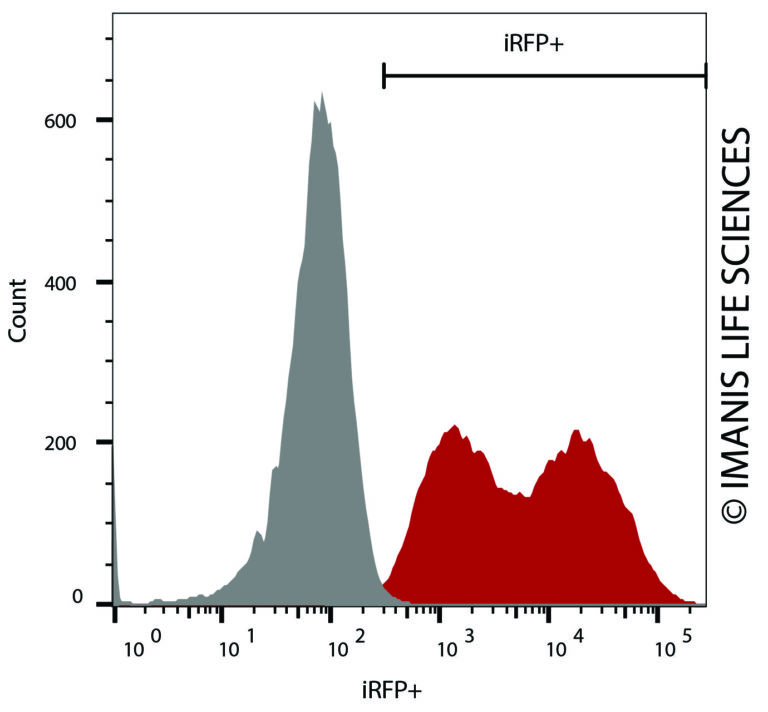 A549-iRFP-Puro (red) or control (A549-Fluc-Puro; grey) cells were fixed with paraformaldehyde and analyzed by flow cytometry (20,000 events).
Complete Growth Medium: DMEM supplemented with 10% FBS, 1X Penicillin/Streptomycin, and 1 µg/ml puromycin.
The addition of puromycin to the complete growth medium maintains high reporter expression over continued passage of the cells. It is highly recommended, especially if the cells undergo multiple passages prior to being used for studies.
These cells should be grown in the indicated medium and passaged when they reach confluency. For routine passaging, cells are recommended to be split at a 1:8 ratio every 3-4 days.
These cells are suitable for in vitro and in vivo experimentation. A549 cells are a xenograph model for lung adenocarcinoma and form primary tumor and pulmonary metastases post implantation into immunosuppressed mice.1,2 The iRFP transgene facilitates in vivo and ex vivo imaging of implanted cells. To reduce background autofluorescence, mice should be fed an alfalfa-free diet for at least a week prior to imaging.
The cells can be amplified in vitro and used to generate additional frozen stocks. Cryopreservation of low passage stocks is recommended. Frozen stocks should be preserved in a designated cryopreservation medium.
These cells were generated via lentiviral vector transduction. The lentiviral vector used for transduction was a self-inactivating (SIN) vector in which the viral enhancer and promoter have been deleted. Transcription inactivation of the LTR in the SIN provirus increases biosafety by preventing mobilization by replication competent viruses and enables regulated expression of the genes from the internal promoters without cis-acting effects of the LTR3. Nevertheless, all work with these cells should be performed under biosafety-level 2 (BSL2) conditions by trained personnel. Institutional requirements may permit handling of these cells under BSL1 conditions if certain criteria are met.
References:
1Jiang et al. Oncogene. 2001. 20:2254-2263.
2Jenkins et al. Clin & Exp Metastasis. 2003. 20:733-744
3Miyoshi et al. J Virol 1998. 72:8150-8157.

Don’t see what you need in our catalog? Our scientific team engineers cell lines, viral vectors, and assays and provides the characterization data you need to move forward with confidence.